





Read and report vaccine reactions, harassment and failures.

The U.S. Food and Drug Administration (FDA) has approved DENGVAXIA, a live dengue tetravalent vaccine targeting dengue serotypes 1, 2, 3, and 4 for use in children and adolescents aged six through 16 years with a laboratory confirmed history of previous dengue infection and living in dengue endemic area.
DENGVAXIA is not approved for individuals who have no prior history of dengue infection or where the history of previous infection is unknown. Individuals with no prior history of dengue are at an increased risk of developing severe dengue infection should they receive this vaccine and become infected with the dengue virus.
The CDC recommends DENGVAXIA vaccine for use in children aged nine through 16 years with a laboratory confirmed history of past dengue infection and who live in dengue endemic U.S. Territories and Freely Associated States.
Read the Package Information Insert
NVIC strongly recommends reading the vaccine manufacturer package information insert before you or your child receives any vaccine, including the dengue vaccine. Package inserts are published by drug companies making vaccines and list important information about vaccine ingredients, reported health problems (adverse events) associated with the vaccine, and directions for who should and should not get the vaccine.
A link to the dengue vaccine package insert is available below or you can ask your doctor to give you a copy of the vaccine package insert to read before your child is vaccinated. Package inserts are also available on the U.S. Food and Drug Administration’s website, as provided in the link below. It is best to ask your doctor for a copy of the package inserts for the vaccines you or your child is scheduled to receive well in advance of the vaccination appointment.

DENGVAXIA, manufactured by Sanofi Pasteur, is a live, genetically modified dengue virus vaccine that contains the pre-membrane (prM) and Envelope (E) genes from each of the four wild-type dengue viruses, as well as the capsid gene and the replication genes from attenuated Yellow Fever (YF) 17D strain virus (virus vector vaccine).
Each 0.5 mL dose of DENGVAXIA dengue vaccine contains each of the chimeric yellow fever dengue (CYD) virus serotypes 1, 2, 3, and 4. The vaccine also contains 2 mg of sodium chloride, 2.5 mg L-arginine hydrochloride, 0.56 mg essential amino acids (including L-phenylalanine), 0.2 mg non-essential amino acids, 9.38 mg D-sorbitol, 18.75 mg sucrose, 13.75 mg D-trehalose dihydrate, 0.18 mg trometamol, and 0.63 mg urea.
The four CYD viruses (CYD-1, CYD-2, CYD-3, and CYD-4) in DENGVAXIA were created by using recombinant DNA technology that replaced the sequences encoding the pre-membrane (prM) and envelope (E) proteins in the yellow fever (YF) 17D204 vaccine virus genome with those encoding for dengue virus serotypes 1, 2, 3, and 4, respectively. Each CYD virus is cultured individually in Vero cells (African Green Monkey kidney), harvested from the Vero cells and subsequently purified through membrane chromatography and ultrafiltration. The concentrated and purified harvest of each CYD virus is then diluted in a stabilizer solution. The final bulk product is sterilized, filled into vials and freeze-dried. DENGVAXIA dengue vaccine does not contain a preservative.
DENGVAXIA is recommended as a 3-dose series given subcutaneously six months apart.
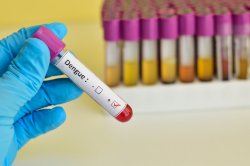
The CDC reviewed all available dengue IgG tests available in the U.S. and found that two tests were satisfactory for sensitivity, but no single test met the specificity requirement of 98 percent. Sensitivity in testing is the ability of a test to accurately confirm the presence of the disease, while specificity is the ability of a test to accurately determine that a disease is not present.
As a result, the CDC states that a two-test algorithm using both the EUROIMMUN Anti-Dengue Virus NS1 Type 1-4 ELISA (IgG) and the CTK BIOTECH On Site Dengue IgG Rapid Test must be used prior to DENGVAXIA vaccination. The use of this two-test algorithm reportedly met the requirement for both sensitivity (greater than or equal to 75 percent) and specificity (greater than or equal to 98 percent). As of May 2024, neither test recommended for use by the CDC has been cleared by the FDA.
IMPORTANT NOTE: NVIC encourages you to become fully informed about Dengue and the Dengue vaccine by reading all sections in the Table of Contents, which contain many links and resources such as the manufacturer product information inserts, and to speak with one or more trusted health care professionals before making a vaccination decision for yourself or your child. This information is for educational purposes only and is not intended as medical advice.