
An historic gathering of the largest mother-led advocacy organizations in the U.S. was coordinated and hosted by Moms Across America (MAA) on Capitol Hill in Washington, D.C. Oct. 12-13, 2026. The leaders of organizations, which reach hundreds of millions of Americans, brainstormed and developed a legislative platform that lists key issues lawmakers need to address to make the world a better place for children and families.
NVIC’s co-founder and president Barbara Loe Fisher joined with MAA founding executive director Zen Honeycutt and representatives of 15 other mother-led organizations to deliberate and create a legislative agenda that included as one of its goals acknowledging that: The principle of informed consent to medical risk taking is a natural right that should guide the ethical practice of medicine and be codified into public health policy and law.
In an Oct. 14, 2026 press release, Zen Honeycutt said “At a critical time in history, over 25 of the largest mother-led organizations in America convened to find common ground on legislative issues promoting health and safety.” Barbara was quoted in the MAA release as saying, “An amazing gathering of moms who are leading advocates for child health issues came together and had a conversation that is going to change the world. I am so inspired by the goals we agreed on to keep our children healthy and happy as we do everything we can to protect them from harm.”
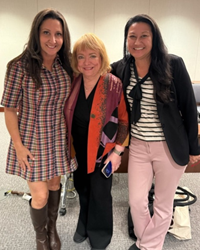
From left to right, Kendall Mackintosh, Barbara Loe Fisher, Zen Honeycutt at Moms Across America Gathering on Capitol Hill Oct. 13, 2026.
It was the first time that a gathering of national advocacy organizations adopted informed consent language in a national legislative platform, which included 24 statements on key issues affecting the health and safety of children and families – from pesticides, regenerative agriculture and clean air, water and food to parental rights, childcare, social media and censorship. Representatives from participating organizations each had five minutes to make a statement about their issue before the legislative platform was discussed and agreed upon by the majority of those attending.
Following is the five-minute statement that Barbara made explaining why the following statement should be included in the group’s legislative platform and the majority of participants voted to make it part of the platform:
Informed consent to medical risk taking is a natural right that should guide the ethical practice of medicine and be codified into public health policy and law.
Informed Consent in Medical Policy & Public Health Law
By Barbara Loe Fisher
Are you pro-vaccine or anti-vaccine? I don’t answer that question, because it is irrelevant. For the charitable National Vaccine Information Center, which I cofounded with parents of DPT vaccine injured children in 1982, it has never been about taking vaccines away or telling people not to vaccinate.
When we worked with Congress on the historic 1986 National Childhood Vaccine Injury Act, a law that for the first time officially acknowledged that government licensed and recommended childhood vaccines can cause injury and death, a law that preserved the right to sue doctors for medical malpractice and drug companies for product design defect until it was gutted by congressional amendments, federal agency rule making and the U.S. Supreme Court, it was always about making vaccine safety a priority and defending the ethical principle of informed consent to medical risk taking.
Defined as a human right by the judges at the Doctor’s Trial at Nuremberg in 1946 to protect humans in medical experiments, the informed consent principle soon was adopted as the central ethical principle not only in scientific experiments, but also in the practice of clinical medicine. The informed consent principle transcends the issue of vaccination.
Every person has the natural and human right to be fully informed about the benefits and risks of a medical procedure that carries a risk of injury or death and be free to make a voluntary decision about whether or not to accept the risk for themselves or their minor child, without being coerced, threatened or sanctioned in any way. The judges at Nuremberg not only declared the informed consent principle to be inviolable but declared the philosophy of utilitarianism to be a pseudo-ethic that cannot be used by doctors to justify human rights abuses in the name of the greater good.
In other words, it is unethical for the state to allow a minority of individuals to be sacrificed for the benefit of the majority. I would argue that it is especially immoral to write off those who are genetically, epigenetically, and environmentally more biologically susceptible to harm from vaccination as necessary losses.
Yet, the philosophy of utilitarianism was precisely the immoral rationale used in the 1905 U.S. Supreme Court decision Jacobson v Massachusetts to affirm the constitutional authority of state legislatures to pass mandatory vaccination laws to “secure the general comfort, health and prosperity of the state.”
Although the high court stated that mandatory vaccination laws can even override individual civil liberties, including freedom of conscience and religion, implicit in the ruling is a state’s right to not mandate the use of vaccines. Reasonable people can disagree about whether the Jacobson ruling was, in fact, constitutional, but that seminal ruling has anchored public health policy and law in the U.S. and been upheld for the past 121 years in case after case challenging it.
As an informed consent advocate who has watched the courts, including the Supreme Court, become politically and ideologically compromised by the medical and pharmaceutical industries and public-private business partnerships, I do not have faith in the court system to protect informed consent rights. NVIC does not support driving a religious vaccine exemption case to the Supreme Court to challenge Jacobson because, if lost and the utilitarian Jacobson ruling is reaffirmed, Americans will be put in chemical chains for the rest of this century.
We advocate for educating state legislators, who under the Tenth Amendment, make public health law governing residents of each state, and persuading them to codify the informed consent principle into state medical policy and public health law. Doing this will liberate the people from the illusion of medical and religious belief vaccine exemptions, which are under strict control of medical doctors and public health officials and are almost impossible to obtain.
Once the informed consent ethic is codified into state law, securing informed consent into federal law can be addressed to prevent further encroachment by the federal government into national vaccine law making, as we saw with the COVID pandemic response that included a first-time federal vaccine mandate. Clearly, federal health officials are seeking to mandate vaccines even though, constitutionally, their disease control authority is mostly limited to policing national borders and inter-state commerce.
God gave us free will and the journey we take on this earth is defined by the choices we make. If we cannot make choices, our souls cannot have free expression and the journey is not our own. And the choices we make about what is done to our bodies and the bodies of our children are among the most profound ones we will ever make, which is why we must be free to make them.
Because If the state can tag, track down and force individuals to be injected with biologicals of known and unknown toxicity today, then there will be no limit on which individual freedoms the state can take away in the name of the greater good tomorrow.
At the end of the day, codifying the informed consent principle into medical policy and public health law builds a firewall between the people and those who would exploit our bodies for power and profit. I cannot think of an ethical principle that is more important to codify into U.S. law than that one.






Leave a comment
Your email address will not be published. Required fields are marked with an *